What you think will happen with AI in five years might already be happening in one or two.
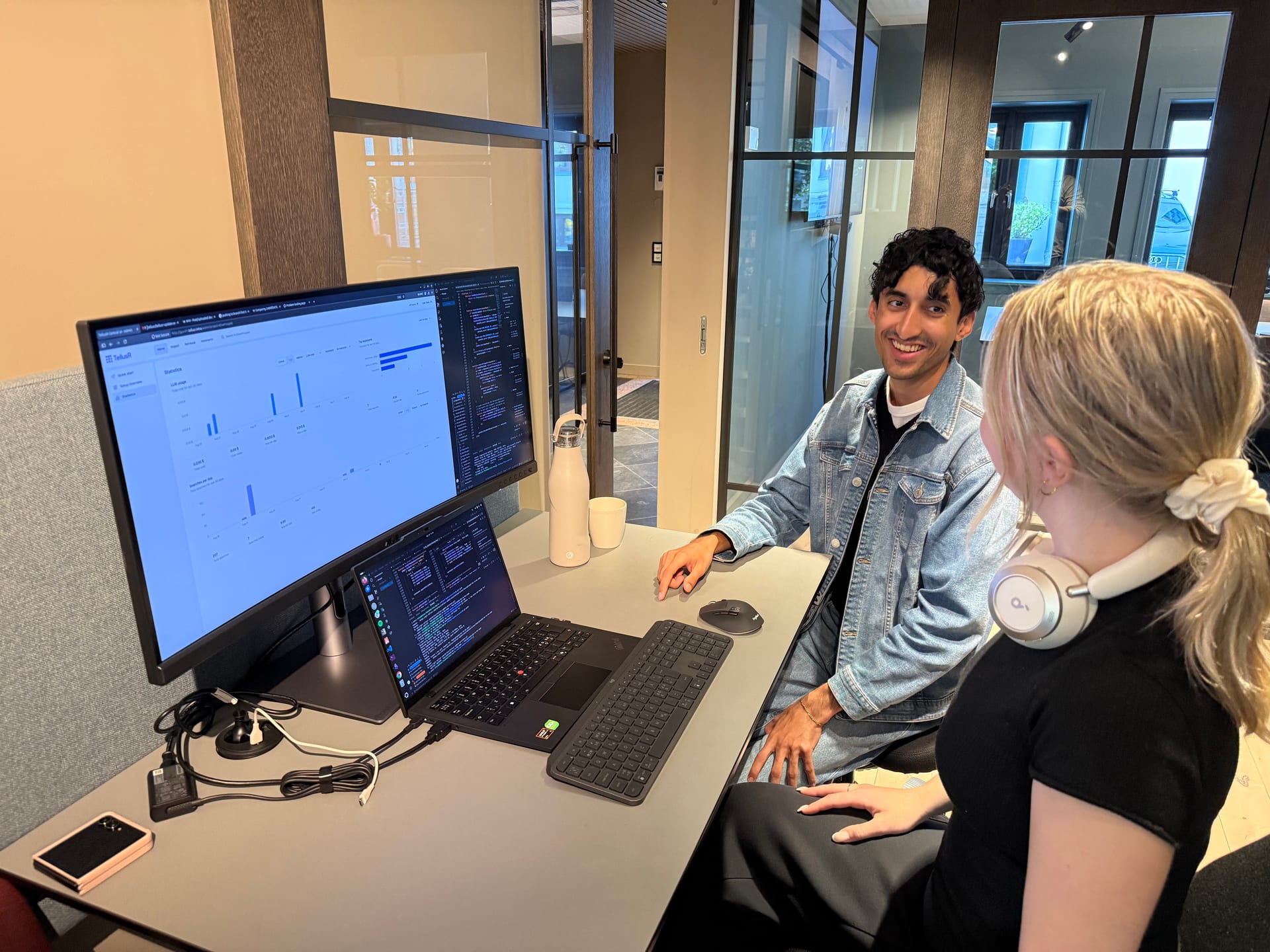
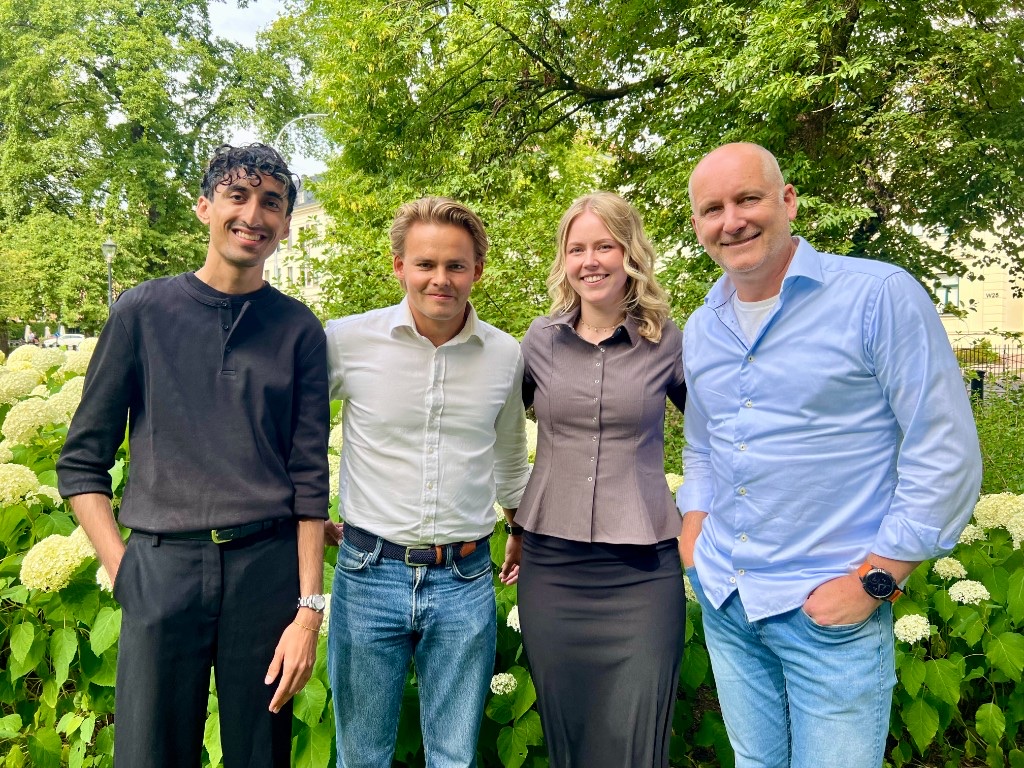
The pace of technological development is pretty raw. Hasan Elahi (26) knows all about that. TellusR has now brought in the newly minted software developer together with data scientist Elise Skilbred Langerød (25) and customer lead Georg Baumann (29), to gear the company for the growth ahead.
And all three have a very conscious relationship with the technology they will now be working with.
The university had to “catch up”
Take Elise, for example.
While most of us were trying to find some peace on the rocks this summer, she was deep in Bane NOR’s databases trying to figure out why Norwegian trains actually run late.
It was not just about numbers on a screen.
– We got to sit with the train dispatchers and see how they actually work to resolve all kinds of conflicts around where the trains should go. Seeing that kind of problem-solving in practice is incredibly exciting. That’s why I want to work in IT: it is always about solving problems.
She is part of the very first cohort in Norway with a bachelor’s degree in artificial intelligence from the University of Bergen, and has a master’s in computer science.
– Studying AI right now must be a bit like shooting at a moving target?
– Yes, they lacked the competence when we started, so they had created entirely new courses just for us. But they also had some existing subjects in machine learning and deep learning, which we took as well. The university was simply forced to catch up with the development in artificial intelligence!
As she now sets out to solve problems for TellusR’s customers, the goal is crystal clear: it has to serve a practical purpose.
I don’t want to solve a problem just because it is fun to solve. It has to help our company move forward. I want to contribute actual value.
He learned the craft by combing through the tech giants
To find that value, you often have to go down into the code. That is Hasan’s domain. Before he took a master’s in Data Science at NMBU, he worked in Munich, the United Arab Emirates and the UK with AI for the tech giants.
Just from a slightly unexpected angle.
– What does an AI patent engineer actually do?
– My job was to analyse patents that had been rejected for one reason or another. These were machine learning models from Huawei, Microsoft and similar players. My task was to find out exactly why they were rejected, and how we could argue against the decision to get them approved, says Elahi.
That deep understanding of how the technology works in practice also led him to build his own open source project, Elahi UI.
A library he built because he was tired of developers having to buy individual components from a hundred different places and ending up with inconsistent interfaces.
People quickly started sending emails asking if they could use what he had built.
– Why did you choose TellusR, of all places, now?
– The fact that TellusR has been working with AI since 2012, before it was even “a thing”, is exciting. There is an incredible amount of knowledge and experience sitting in the history here, and it will be very interesting to see how our solutions can set the direction going forward.
At the same time, he warns against blind faith in the technology.
– There is a challenge in the balance between how useful AI can be, and how safe it actually is. For now, you cannot lean a hundred percent on the information AI gives you.
When the AI model hands you a colleague’s payslip
Security, data control and transparency are among the first things Georg Baumann is taking on.
He comes from the consulting track at the prestigious Nova School of Business & Economics in Lisbon, and until recently sat in the middle of the Microsoft machinery at Crayon.
– Why did you leave “the dark side”?
– Hehe. There is a lot of frustration in the big American companies. They have … good, big words. They say they are the best at what they have, and that everything is streamlined. But when you get into the substance, you notice that an incredible amount of things stall.
He sees many Norwegian companies throwing themselves at large AI models without having the foundation in place. Document control in particular is, according to the newly hired customer lead, “pretty shaky”.
– What happens when you implement AI without document control?
– To put it bluntly: if you don’t have labels on your documents, and you let a language model loose on them ... Well, if 70-year-old Laila searches for her payslip and instead gets a colleague’s payslip, that is not exactly ideal. You have to have control of your own data, and know exactly where the model is pulling information from.
As a former consultant, Baumann is concerned that Norwegian companies should not try to solve everything at once. Many hesitate to take the next step because they fear unpredictable token costs, or because the project feels too big.
– Many stop because they want to fix everything at once. That only builds barriers. The uncertainty out there is a blocker for a lot of companies right now, he says, adding:
But for those who dare to take control of their own foundation, there are enormous opportunities ahead.